 By Olivia Miller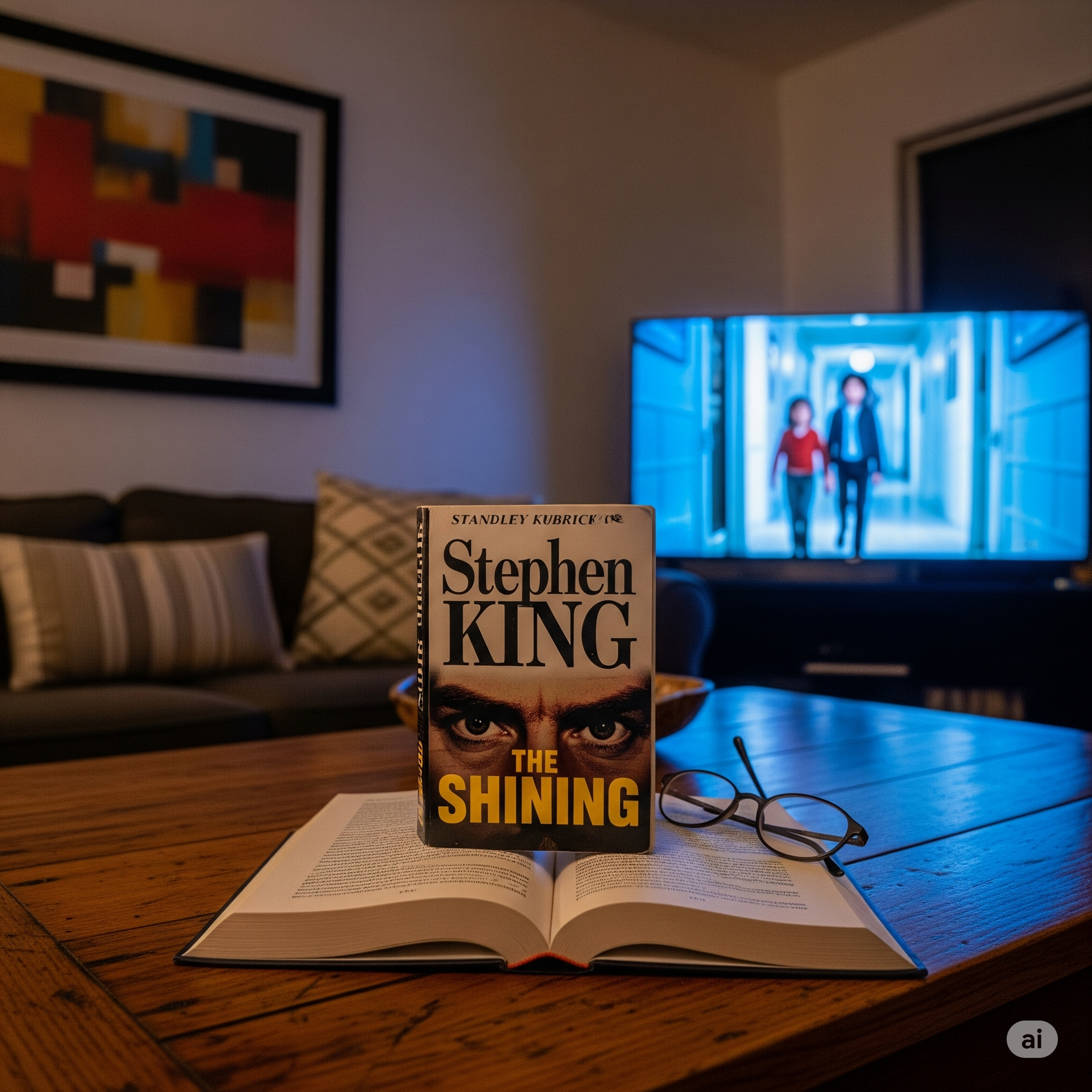
If you’re a horror fan like me, there’s something truly exciting — and a little nerve-wracking — about seeing a book you loved turned into a film. Will it live up to the story? Will it keep the same eerie vibe?
Will it butcher your favorite scene? When a horror adaptation gets it right, it’s pure, chilling magic.
The truth is, cinema owes a lot to horror literature. Many of the most iconic and terrifying films in history were born from books.
And while some creative liberties are always taken, it’s fascinating to see how stories designed to haunt our imaginations find new ways to scare us on the big screen.
Below are some of the best and most successful horror films that were adapted from books.
Some are classics, others more recent hits, but all of them prove that fear knows no boundaries — especially between page and screen.
The Shining – Stephen King
Let’s start with the obvious. Few horror films are as revered as The Shining, directed by Stanley Kubrick.
And few authors have had as many of their works adapted as Stephen King — the undisputed master of modern horror.
Based on the 1977 novel, The Shining follows Jack Torrance, a writer who takes a job as the winter caretaker of a secluded mountain hotel.
As his isolation deepens, he spirals into madness while supernatural forces take hold of the building.
The film is widely considered a masterpiece of psychological horror. But it’s worth noting: King himself famously disliked the adaptation, feeling it stripped away the emotional core of his characters.
Still, both versions are essential in their own way — and intriguingly different.
The Exorcist – William Peter Blatty
Few films have had the cultural and psychological impact of The Exorcist.
But long before the 1973 movie terrified audiences around the globe, it was a novel — written by William Peter Blatty in 1971.
Inspired (very loosely) by a real-life exorcism case, the story follows young Regan, a girl who begins to exhibit terrifying behavior.
What unfolds is a battle between science, faith, and something far darker.
Blatty also wrote the screenplay, resulting in a remarkably faithful adaptation. The film broke records, stirred controversy, and became a horror landmark.
But the book is just as powerful — with chilling detail and narrative depth that no special effect can replicate.
It – Stephen King
Yes, he’s back again — and rightfully so. It, published in 1986, is one of Stephen King’s longest and most ambitious novels.
It’s also spawned two major screen adaptations: a 1990 TV miniseries and the blockbuster two-part films released in 2017 and 2019.
The story spans two timelines — childhood and adulthood — following a group of friends battling a shape-shifting entity that preys on fear, often taking the form of the infamous Pennywise the Dancing Clown.
The recent films were major box office hits, especially the first. They condense a lot from the book but retain its emotional core and terrifying set pieces.
It’s a perfect example of horror that combines the supernatural with deep human emotion and trauma.
Rosemary’s Baby – Ira Levin
Originally published in 1967, Ira Levin’s Rosemary’s Baby became an instant bestseller.
Just a year later, Roman Polanski brought it to life on screen in a now-legendary adaptation — widely regarded as one of the greatest psychological horror films of all time.
The story follows Rosemary, a young wife who moves into a mysterious apartment building with her husband.
After she becomes pregnant, she starts to suspect that her neighbors — and even her husband — are part of a satanic cult with sinister plans for her child.
The horror here isn’t flashy or gory. It’s slow, paranoid, and deeply unsettling, with a creeping sense of dread that builds masterfully.
Both the book and the film are still shockingly relevant — and equally terrifying.
The Woman in Black – Susan Hill
For fans of classic Gothic horror, The Woman in Black is a haunting gem.
Written by Susan Hill in 1983, the book channels the eerie spirit of Victorian ghost stories with foggy landscapes, creaky old mansions, and unsettling silences.
The plot follows Arthur Kipps, a young solicitor sent to settle the affairs of a recently deceased client in a remote village.
There, he encounters the legend of the Woman in Black — a vengeful ghost whose appearance is followed by the death of a child.
The 2012 film adaptation, starring Daniel Radcliffe, does justice to the novel’s atmosphere. It doesn’t rely on jump scares; instead, it builds quiet, atmospheric horror that lingers long after the credits roll.
It’s a faithful and beautifully shot film that honors the spirit of the book.
Salem’s Lot – Stephen King
One of King’s more underrated works, Salem’s Lot was published in 1975 and remains one of his most atmospheric and traditional horror novels.
It’s essentially Dracula set in small-town America — and it works brilliantly.
The story follows writer Ben Mears as he returns to his hometown, only to discover that its residents are being turned into vampires.
What begins as a slow burn quickly escalates into a full-blown vampire invasion, with rich character development and eerie tension throughout.
Salem’s Lot has had multiple adaptations — including a 1979 TV miniseries and a 2004 remake — and a new version is in development. While the visual versions are good, the novel delivers that unique, creeping dread King is so good at building.
When Books Become Films… and Fear Comes to Life
Not every adaptation hits the mark — and as book lovers, we know that pain all too well.
But when a horror novel is adapted with care and vision, it becomes something powerful: a story that haunts both your mind and your eyes.
Books give us the freedom to imagine the horror. Films give us the horror imagined by others — and when both work in tandem, the effect is unforgettable.
So, if you’re looking to double your dose of fear, I highly recommend diving into the books behind these films.
You’ll uncover richer details, deeper character insight, and that intimate, solitary dread that only a good horror novel can deliver.
Then, once you’re properly scared, press play — and watch the terror come alive.