
 By Mia Wilson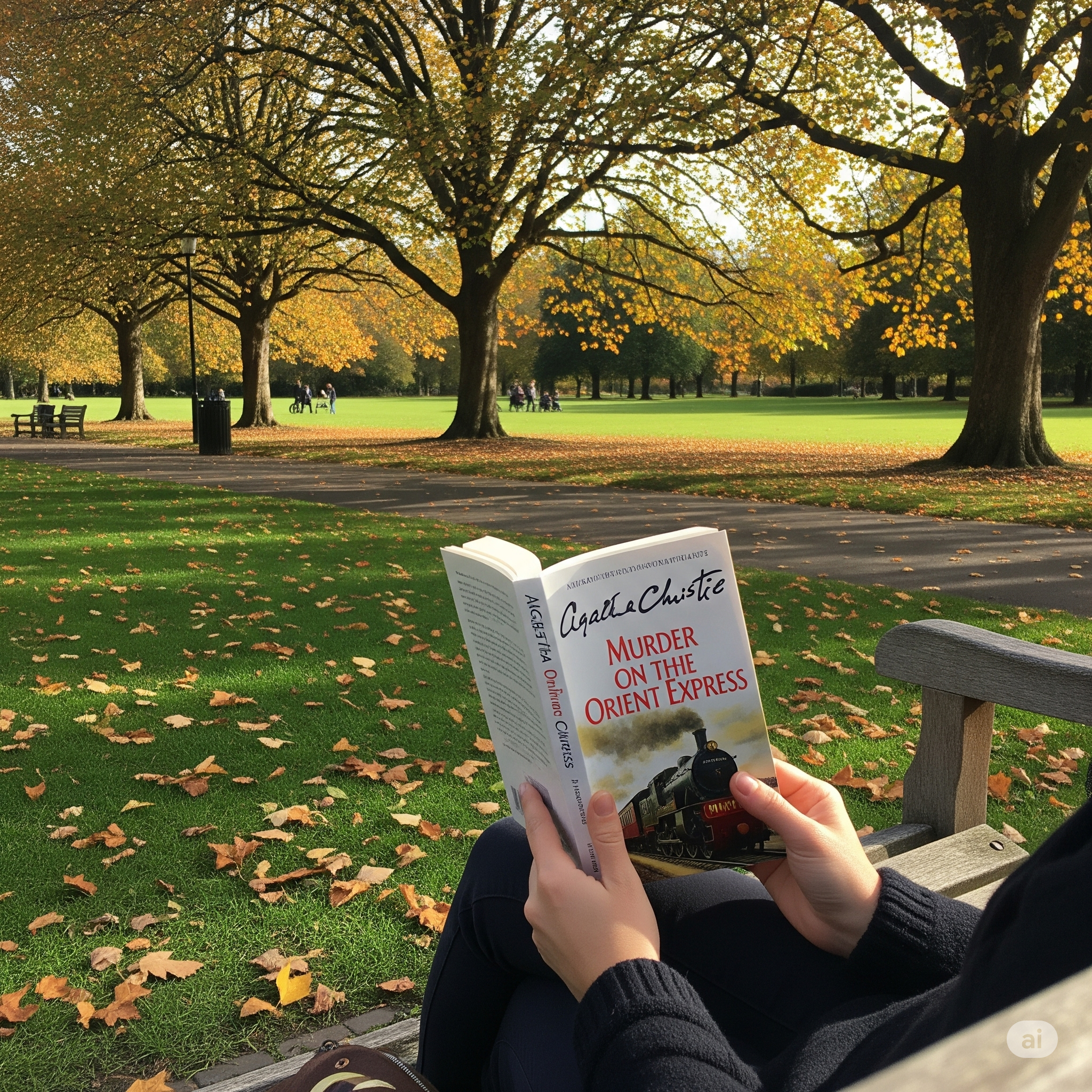
Some books stand the test of time not just because they’re good, but because they reshape an entire genre. Murder on the Orient Express, first published in 1934, is one of those books.
Written by Agatha Christie, the undisputed queen of crime fiction, this novel not only cemented Hercule Poirot as one of literature’s most iconic detectives but also set a benchmark that many mystery writers still aspire to reach.
Reading Murder on the Orient Express in the 21st century is a reminder of how satisfying a well-crafted mystery can be. It doesn’t rely on graphic violence or wild twists — instead, it seduces readers with elegance, wit, and psychological insight.
Even if you already know the plot (thanks to film adaptations or pop culture references), the experience of reading this book remains captivating, intelligent, and unexpectedly emotional.
The Plot: A Crime Committed in Isolation
The story unfolds aboard the luxurious Orient Express, a train that travels across Europe during the winter.
Among its distinguished passengers is none other than Hercule Poirot, returning from a case in the Middle East.
Everything seems normal — until one of the passengers, an American named Samuel Ratchett, is found murdered in his locked cabin.
He has been stabbed multiple times, and the door was bolted from the inside. The train, halted by a snowstorm, is cut off from the outside world. The murderer must be one of the people on board.
With time to kill and a mystery at hand, Poirot begins his investigation, interviewing each passenger. What he uncovers is a tangled web of lies, hidden identities, and a connection to a tragic crime from the past.
Hercule Poirot: A Detective Who Listens to More Than Logic
If Sherlock Holmes is the embodiment of cold logic, Poirot is its charming and refined counterpart.
With his meticulously groomed mustache, quiet vanity, and belief in the power of the “little grey cells,” Poirot is more than just intelligent — he’s deeply attuned to human behavior.
In this book, Christie gives Poirot one of his most complex challenges. And he rises to it not by chasing clues across cities, but by observing, asking precise questions, and piecing together the emotional truths behind each statement.
The investigation is driven by dialogue and insight, rather than action, which makes the pace more deliberate than modern thrillers. But that’s precisely what gives the story its charm.
This is a mystery for readers who enjoy solving puzzles with patience and attention to detail.
A Cast of Curious and Complex Characters
One of the novel’s great strengths is its cast. There are 12 passengers — a cross-section of social classes and nationalities, each with their own secrets. Among them: a Russian princess, an English governess, an Italian soldier, a Swedish missionary, and many others.
At first glance, they appear to be strangers. But Poirot slowly reveals that they’re all connected to a heartbreaking case: the kidnapping and murder of little Daisy Armstrong — a fictionalized version of the real-life Lindbergh baby case that shocked the world.
This connection transforms the narrative. The murder of Ratchett is no longer just a random act of violence — it’s tied to collective grief and unresolved trauma.
The story becomes not only a whodunit, but a meditation on justice, revenge, and moral ambiguity.
The Ending: One of the Boldest Twists in Crime Fiction
It’s impossible to discuss Murder on the Orient Express without touching on its ending — no spoilers here, of course. But it’s safe to say that Agatha Christie breaks the rules of the detective genre in a way that is both daring and thought-provoking.
Rather than delivering a simple answer to “who did it,” she forces the reader to ask: What is justice? Who has the right to deliver it? The solution is not just clever — it’s ethically complex.
It challenges our assumptions and stays with us long after the final page.
That’s what elevates this book from a mere mystery to a timeless piece of literature. Christie doesn’t just entertain — she provokes, in the best sense of the word.
Reading It Today: Does It Still Hold Up?
Many readers ask: is it still worth reading Agatha Christie today, with so many modern thrillers out there?
The answer is an emphatic yes — and Murder on the Orient Express is the perfect starting point.
The prose is clear and elegant. The setting — a snowbound luxury train — is both nostalgic and atmospheric. And the mystery remains irresistible.
Even if you know the ending, it’s worth rereading to admire how meticulously Christie builds the case, hints at the truth, and constructs each character’s alibi.
What makes this book timeless is that it doesn’t rely on technology, action sequences, or shocking violence.
Its strength lies in intelligence, emotional depth, and the craft of storytelling — all things that never go out of style.
Adaptations: The Classic vs. The Cinematic
The novel has been adapted several times, most famously in the 1974 film and more recently in the 2017 version directed by and starring Kenneth Branagh.
The latter is visually stunning, with sweeping cinematography and a star-studded cast. But many fans felt that the modern adaptation lost some of the original’s subtlety and nuance.
That said, the film is a great complement to the book — but not a replacement. The richness of the story lies in its details, dialogue, and the slow, steady unraveling of secrets.
No camera can replicate the pleasure of following Poirot’s thoughts as he quietly deciphers a room full of liars.
No Conclusion — Just an Invitation
Murder on the Orient Express isn’t just a classic; it’s a masterclass in how to build a compelling, thought-provoking mystery.
Agatha Christie proves that great storytelling doesn’t need explosions — it needs insight, elegance, and the courage to challenge expectations.
If you haven’t read it yet, now is the perfect time. And if you have, it’s worth revisiting with fresh eyes — maybe a bit older, a bit wiser, and more attuned to the layers beneath the plot.
Step aboard the train. Sit beside Poirot. Watch closely. Ask questions. And prepare for an ending that — even nearly 90 years later — still manages to shock, impress, and satisfy in equal measure.